

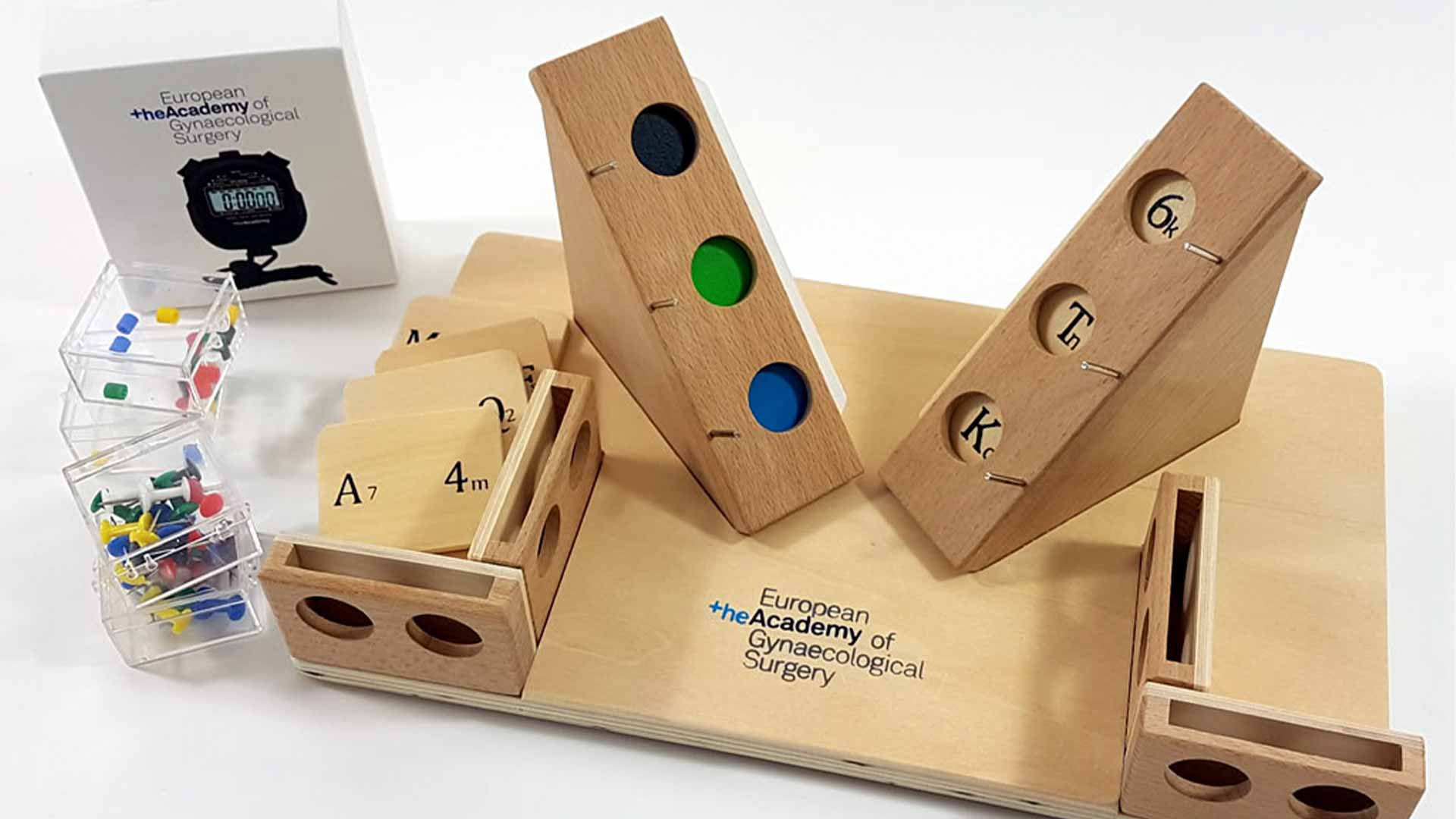
Modern gynaecological endoscopy demands more than theoretical knowledge. It requires refined psychomotor abilities, spatial awareness, precision, and structured decision-making. For this reason, the GESEA Educational Programme integrates a series of validated training tools designed to elevate the practical skill level required to safely perform basic endoscopic procedures.
It is scientifically proven that structured simulation-based training before entering the operating room significantly improves surgical performance, enhances patient safety, and accelerates the surgical learning curve. GESEA embraces this evidence-based approach by making practical laboratory training an essential step in the certification pathway.
Why Practical Skill Lab Training Is Essential
Every endoscopic surgeon must develop:
Camera handling skills
Hand–eye coordination
Bi-manual coordination
Fine motor precision
Structured intra-corporeal suturing ability
These competencies cannot be acquired through observation alone. They must be trained, measured, and validated in a controlled environment before being applied in real surgical settings.
GESEA achieves this through three core practical assessment tools: LASTT, SUTT, and HYSTT.
LASTT – Laparoscopic Skills Training and Testing
LASTT is a validated practical test that measures competence in basic laparoscopic psychomotor skills within a simulated uterine environment.
It evaluates:
Camera navigation
Hand–eye coordination
Bi-manual coordination
The LASTT model reproduces the spatial orientation and anatomical planes of the female pelvis. The model is positioned inside a pelvic trainer, allowing candidates to simulate realistic laparoscopic movements.
LASTT represents one of the three mandatory practical exercises used in the GESEA skill assessment. It provides objective measurement of performance and ensures that fundamental laparoscopic abilities are mastered before progressing further.
SUTT – Suturing and Knot Tying Training and Testing
Suturing is one of the most technically demanding aspects of endoscopic surgery. The SUTT model focuses exclusively on the acquisition and assessment of stitching and intra-corporeal knot-tying skills.
Through a structured series of exercises, SUTT evaluates:
Precision of needle handling
Quality of stitches
Ability to perform complex intra-corporeal knots
Fine motor control
The SUTT model consists of a foam base and dedicated suturing pad placed within a pelvic trainer. Importantly, SUTT measures suturing quality independently of broader medical decision-making — isolating and objectively assessing technical motor skills.
Like LASTT, SUTT is one of the three core exercises required within the GESEA practical skill assessment.
HYSTT – Hysteroscopic Skills Training and Testing
Endoscopic competence also requires mastery in hysteroscopy. The HYSTT model evaluates fundamental hysteroscopic psychomotor skills within a simulated uterine cavity.
Key competencies assessed include:
Camera navigation in a “key-hole” environment
Orientation within the uterine cavity
Fine hand–eye coordination
Controlled instrument handling
The HYSTT model reproduces the spatial configuration of a normal uterus and is placed within a female genital model, allowing realistic training in hysteroscopic navigation.
HYSTT completes the triad of validated GESEA practical assessment tools and ensures balanced competence in both laparoscopic and hysteroscopic domains.
Standardised Training, Objective Evaluation
The strength of the GESEA Programme lies in its standardisation and objectivity. Each training tool is validated and integrated into a structured evaluation framework. Performance is measured using predefined criteria, ensuring transparency and consistency across centres worldwide.
For a detailed overview of the official training tools catalogue, visit:
🔗 https://esge-services.org/training-tools/
At the GESEA Training Center in Naples, candidates train on these validated models under expert supervision, ensuring that competence is built progressively and responsibly.
Because before performing surgery, one must first master the skills.
📍 GESEA Training Center – AOU Federico II of Naples
Building 9 – Ground Floor
Via Pansini, 5 – 80131 Naples, Italy
📞 +39 081 878 05 64
📧 info@newcongress.it
📧 contact@geseanapoli.com