

In surgical education, where you train can be just as important as how you train.
A training center is not simply a physical space equipped with instruments and simulators. It is an educational environment where knowledge, technology, mentorship and assessment come together with a common objective: helping physicians develop their skills according to structured and recognised standards.
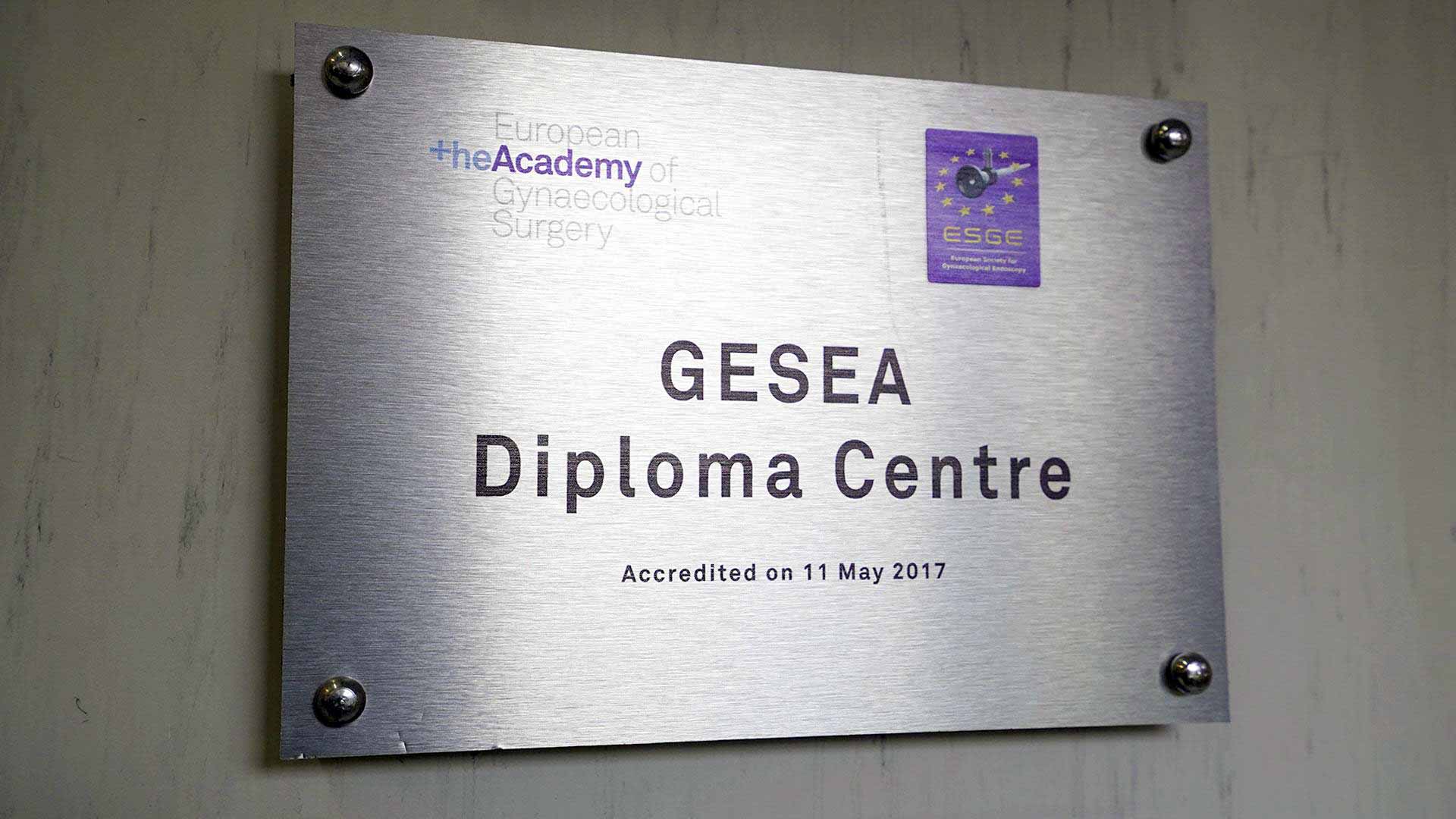
For this reason, accreditation and official recognition have an important meaning. The plaque displayed at a training center may appear to be a simple symbol, but behind it lies something much more significant: a commitment to quality, education and continuous professional development.
Accreditation Is More Than a Title
Recognition as an educational center should never be considered merely a name displayed on a wall.
It represents the commitment required to create and maintain an environment dedicated to high-quality surgical education.
This means providing appropriate facilities and equipment, offering structured educational activities and, above all, ensuring that participants are supported by experienced tutors who understand that teaching surgery requires more than demonstrating a technique.
It requires observation, feedback, assessment and mentorship.
Accreditation is the visible expression of an invisible commitment: the daily work required to make education effective.
The Importance of the Training Environment
Learning surgical skills requires a very particular environment.
Young physicians need the opportunity to practise without the pressure of the operating room. They need time to repeat a task, understand an error, receive feedback and try again.
They also need to be surrounded by professionals who can transform a technical exercise into a meaningful educational experience.
This is one of the fundamental differences between simply having access to a simulator and participating in a structured training programme.
Technology provides the tools.
Education gives those tools a purpose.
A Place Where Skills Can Grow
At the GESEA Training Center at AOU Federico II of Naples, training is conceived as a progressive process.
Participants can develop and assess their psychomotor abilities within a structured environment before transferring those skills to clinical practice.
The objective is not simply to complete an exercise or pass an examination. It is to understand how each individual skill contributes to the development of surgical competence.
Hand-eye coordination, instrument handling, precision, spatial orientation and suturing are not isolated abilities. Together, they form the technical foundation upon which more advanced surgical skills can be built.
The Human Value of Mentorship
Even the most advanced training equipment cannot replace the role of an experienced tutor.
Mentorship remains one of the most important elements of surgical education.
A tutor can recognise details that the trainee may not perceive: an unnecessary movement, an inefficient position, an incorrect approach or simply an opportunity to perform a task more precisely.
At the Naples Training Center, this interaction between trainee and tutor is an essential part of the educational experience.
Training therefore becomes more than repetition. It becomes a continuous dialogue between practice, observation, feedback and improvement.
A Community Dedicated to Education
An educational center is also a meeting point.
Throughout the year, physicians with different levels of experience come to Naples with the same objective: to learn, improve and challenge themselves.
This creates something that extends beyond the individual training session.
It creates a community.
Participants exchange experiences, meet colleagues, interact with tutors and become part of an international educational pathway dedicated to the advancement of gynaecological endoscopic surgery.
This human dimension is one of the greatest values of training in a recognised educational environment.
Quality Education Requires Continuous Commitment
Maintaining high standards in medical education is an ongoing process.
Surgical techniques evolve. Technology changes. Training methods improve. New generations of physicians arrive with different educational needs.
For this reason, an educational center must evolve as well.
Investment in equipment, faculty development, simulation, new technologies and educational programmes is essential to ensure that training remains relevant to contemporary surgical practice.
Recognition therefore represents not only what a center has achieved in the past, but also a responsibility for its future.
More Than a Plaque on the Wall
Behind every accreditation, every certification session and every physician who completes a training programme, there are hours of preparation, teaching, practice and assessment.
The plaque displayed at the Training Center represents all of this.
It represents a place dedicated to learning.
A place where mistakes can become lessons, where skills can be refined and where physicians can prepare themselves for the responsibilities of the operating room.
Because excellence in surgical education does not happen by chance.
It requires the right programme, the right mentors and, above all, the right environment in which to grow.
GESEA Training Center – AOU Federico II of Naples
Building 9 – Ground Floor
Via Pansini, 5 – 80131 Naples, Italy
Phone: +39 081 878 05 64
contact@geseanapoli.com
info@newcongress.it